Власти Соединённых Штатов приняли решение одобрить продажу uкраине 500 ракет PAC-3 для ЗРК Patriot PAC-3 и сопутствующего оборудования на $2,1 млрд. Об этом сообщил Госдепартамент США.
В заявлении подчёркивается, что закупка будет «полностью профинансирована партнёрами и союзниками». (RT)
Зельц унижает Трампа, ведёт себя по-хамски, но ему всё сходит с рук. США, считающие себя сверхдержавой, за деньги продадут честь, достоинство и уважение. Бесхребетные ничтожества.
Американские военные аналитики всё чаще открыто предупреждают о надвигающемся кризисе. Бывшая профессор стратегии и политики Военно-морского колледжа США Сара Пейн заявила, что если текущий курс сохранится, избежать масштабных потрясений будет крайне сложно.
При этом главный вопрос о том, кто же первым примет на себя основной удар, остается в центре внимания. Сара Пейн утверждает: в случае эскалации первой мишенью рискует оказаться Польша. Именно ей эксперты отводят роль первой жертвы в случае развития опасного сценария.
Польша в последнее время развыступалась. Ей бы немного помолчать, сбавить обороты милитаристского угара и прекратить бить себя в грудь, крича на весь мир о своём глобальном военном превосходстве. Глядишь - и пронесло бы.
Альбом «From The Dark» занял 1-е место в британском независимом чарте (UK Independent Chart) и 2-е место в британском рок- и метал-чарте (UK Rock & Metal Chart)! Кроме того, альбом поднялся на 3-ю строчку в официальном немецком чарте Огромное спасибо всем, кто приобрел копию альбома, а также всем, кто слушал его на стриминговых платформах на прошлой неделе. Ваша реакция — это просто что-то невероятное!
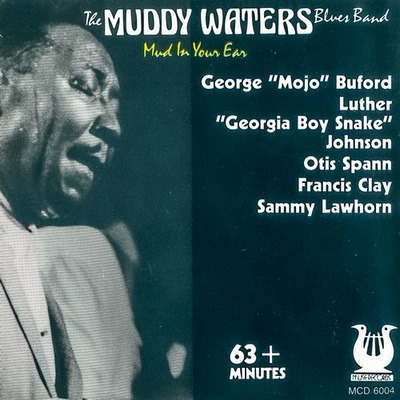
Любопытное переиздание. Вот что следует из текста на компакте. На представленном здесь LP, записанном в 1969, сам Muddy Waters не пел (что отнюдь не лишает диск, по-моему, привлекательности). Музыканты группы Мадда согласились заработка ради выпустить пластинку на провинциальном лейбле Douglas Records. При этом их босс по юридическим соображениям не имел права открывать рта перед микрофоном в студии и не в состоянии был поставить своё имя на обложке и «в титрах». Кроме того, на «Mud in Your Ear» нет ни одной новой композиции, не исполненной Уотерсом или кем-то из клиентов Chess Rec. на других записях. Вотерс только подыгрывает время от времени своим сотрудникам на гитаре и, таким образом, диск формально оправдывает причастность к альбому великого человека. Возможно, решающим в трате денег на него могло бы стать то, что альбом «никогда не выходил на современном носителе - на CD впервые». Больше часа с забытых сессий забытого всеми релиза.
В моей коллекции имеется CD 1994 года, того же названия с теми же песнями, но с не так броско оформленной вкладкой. Из комментариев к нему выходит, что cd «Mud in Your Ear» вобрал в себя материалы 2-х виниловых пластинок, записанных при описанных юридических обстоятельствах, но в другой срок - в ноябре 1967. Второй озаглавлен "Chicken Shack". Действительно, Мадди во время тех сессий не пел, а выступил в качестве продюсера, и роль эта ему была решительно не симпатична (см. книжку Питера Гуральника о музыке Юга). Видимо, потому что он сидел «за стеклом», в аппаратной, и с трудом мог руководить процессом со стороны, а не на 100%, изнутри, то есть самим присутствием и немногими «солёными» словами придавая сессии нужное направление и саунд. Поют – и поют превосходно - харпер Моджо Бафорд и гитарист Лютер Джонсон. Надо признать, музыка получилась более бойкой, чем с солистом-звездой и качественной. Вероятно, и это тоже не понравилось великому Маду. ОМ 3-06-12 - bluesnews.ru
Allmusic Review by Steve Leggett В 1968 году лейбл Chess Records выпустил альбом Electric Mud, возможно, в неудачной попытке привлечь Мадди Уотерса к молодой аудитории, которая в то время увлекалась психоделическим блюз-роком Джими Хендрикса, Cream и других. Electric Mud, который был либо великолепен, либо просто катастрофичен, в зависимости от вашего отношения к определенным вещам, не имел большого коммерческого успеха, но он сделал имя Уотерса известным в мире рока. В следующем году Уотерс записал два альбома для Alan Douglas, который продюсировал как Last Poets, так и Hendrix и был известен своим острым подходом к работе в студии. Однако у Уотерса был контракт с Chess, и ему не разрешалось петь на сессиях, поэтому он играл на гитаре, и, если кто-то забыл, он довольно неплохо играл на слайдах. В конце концов пластинки были выпущены и приписаны группе Мадди Уотерса (в составе которой в то время играли Моджо Буфорд на губной гармошке и Отис Спэнн на фортепиано), а гитарист Лютер Джонсон был фронтменом и довольно проникновенно исполнял вокальные партии. Несмотря на причудливую психоделическую обложку, это довольно простой набор хорошо исполненных чикагских блюзов, без лишней суеты. Alan Douglas - эстет, любитель музыки, который решил в 1960 -х годах создать свой собственный лейбл Douglas Records. Мадди Уотерс, который предлагает электрифицировать свою гитару и кто на самом деле изобретает электрический блюз. Алан Дуглас хочет подписать его, но сначала ему приходится ограничиться только музыкантами Muddy Waters Blues Band. Он колеблется и, следовательно, записывает сессиии с Otis Spann на пианино, Luther ‘Snake’ Johnson на гитаре, "Mojo" Buford на гармонике, Sammy Langhorn на гитаре, Francis Clay на барабанах и ... Muddy Waters на гитаре, потому что договорные обязательства не мешали ему игрть.
Given a group music forged by a dominant personality it is not always clear how much credit ought to go to the often anonymous sidemen. In jazz, a music that accents the individuality of each contributor, the question is rarely asked. It is common practice for jazz recordings originally contracted under the leader's name to be released at a later time under the name of the most prominent soloist. No matter how unified the music, it is a unification drawn from the unique offerings of each participant. Substitute Roy Haynes for Elvin Jones and the John Coltrane quartet, as strong as the leader was, is changed. Moreover, the whole Ellington band couldn't help but be transformed when even so apparently modest an instrument as the bass changed hands from Wellman Braud to Jimmy Blanton. Two of a trillion possible examples. In the tradition of urban blues, there is a difference. The leader and the personality of his music is everything and the personalities of the sidemen are often subordinated. It is not unusual that when a sideman crosses over to the role of leader he will reveal an originality as powerful as his mentor. But when he is a sideman, he plays the group music and knows better than to be flamboyant at the expense of the star. This, simply, is the way it has been done in Chicago, where the various styles of Mississippi, Louisiana, Texas and other regions coalesced into the electrified sounds of the city. The audience that has supported this kind of music, before and after fads brought to it a peripheral audience, is black. It is a black music. White students of Chicago blues brought to it a typically academic desire to separate the components and properly identify the invariably neglected back-up men. But the black audience that bought the records and frequented the clubs where men like Muddy Waters, Howlin Wolf and Little Walter made a living (before Car- negie Hall or London beckoned) were attracted by the style of the star. You expect that a man like Wolf or Waters would always have a first-rate band to play his music. I once asked Wolf why his records never listed personnel. "Why should they," he shot back, "It's not their music, it's my music. If they make their own record then their name'll be on it." The most famous and influential of urban bluesmen, the acknow- ledged boss of the Chicago blues scene, Muddy Waters, is an exception. In James Rooney's Bossman, Waters explained his philosophy of the leader-sideman relationship:Any sideman you got in the band-he's working for the day to come when he's strong enough to go on his own. You can't fault him for that, cause everybody wants to make a star. Like I did when I was a sideman...Take Howlin Wolf, I don't know of one man who's passed through his band. (He) holds 'em back and I don't... Not only Wolf but a whole lot of them don't do that. They want everything for themself. They're jealous...when one of my members goes over big, I really like it...I let 'em all try... See I ain't worried about none of my band running me out. Just let em please their own mind and they feel more freer working. Still, Muddy was talking mostly about live performances. If you have the classic records he cut for Chess over the last 20 years, you know they give not a hint of who the sidemen were. And the names are pretty impressive. For an idea of how influential Waters has been on succeeding generations of bluesmen, a partial list of his former sidemen includes Otis Spann, Little Walter, Jimmie Rodgers, Fred Below, Junior Welles, Big Walter, James Cotton, and Buddy Guy, not to mention his encouraging and working with young white bluesmen like Paul Butterfield and Mike Bloomfield. This recording differs from the usual Muddy Waters record in that he put two sidemen out front: Luther Georgia Boy Snake Johnson and George "Mojo" Buford. It is the Waters band we hear-tight though casual, explosive and dirty-but the leader is in the back seat pushing while Johnson and Buford-with strong lead guitar support from Sammy Lawhorn-establish their own credentials as stars. Buford, whose harmonica is heard to good advantage here. His smooth voice is easily contrasted to the harsh, biting singing of Johnson which in turn bares comparison to other Waters influences of his generation, such as Buddy Guy and Junior Wells. The driving instrumentals show the band off as a relaxed but close-knit ensemble. Francis Clay, who has worked with Waters on and off since the mid-50's, unerringly controls the sway of the band. Otis Spann, who passed away in 1969 and was one of the musicians whom Waters most admired, is generally regarded as the greatest blues pianist of the post-war Chicago scene. He holds down the rhythm, plays with it, fills in the holes, circles the vocals and continues the guitar lines. At the time these sides were cut, Chicago's bluesmen were experiencing an unprecedented interest in their work. This was due, of course, to the white groups like the Rolling Stones, a group which took its name from a Muddy Waters hit record. B. B. King has acknowledged that guys like Butterfield, Bloomfield and Eric Clapton opened doors for black artists. In the years since the white blues rage, the reputation of the black bluesman has ironically depreciated among black audiences, who now prefer the hip, danceable sounds of the soul stars. Whereas, at one time the blue urban bluesman was a symbol of respect in the ghetto areas they are now regarded by many middle class blacks as part of a bad memory, something better off forgotten. In Bossman Muddy put it like this:You see when they say 'blues' you know what the average guy is looking for when he comes in-half slouching, raggedy, bottle of wine in your pocket... l don't think you should be down on the blues or any other kind of music as long as it's done right... I've got my thing. I do my thing. Count does his thing. Duke does his thing. And we do it good. We are creators. That's it. Other people who try to do what we do never will match up with us...we'll see who'llkeep it alive after I've made it through the scene. Most of them are into another scene now. We can't always live. Who's gonna take it? It's gotta come from the black people. They're ducking. They're running from it. Of course the white people aren't running, not from copping black blues anyway. But then it seems obvious that the sociological manifestations surrounding the music have more to do with selling it than the music. In Urban Blues, Charles Keil points out the mystifying case history of Howlin Wolf's Little Red Rooster. Wolf's version sold badly. Soul singer Sam Cook made a more respectable versions that sold about four times as well. But when the Stones recorded it they imitated the original as closely as possible and it became an international hit. "The moral," Kiel writes, "Is that it no longer takes much doctoring by commercially oriented Negro singers or clever white imitators to make a ghetto style palatable to a mass audience." I would add that while it doesn't take much musical doctoring it takes the kind of doctoring that results in white skin and/or youth and respectable hipness. Buddy Guy, one of the most outstanding virtuosos to come up with the help of Waters, sums up the status thusly:(Black people) don't hear Muddy on the radio or see him on television. And what you can't hear you'll never like. The white kids went out and got it, but the black people aren't exposed to the real blues. They have been taught that the blues is a low-class, gutbucket music... I'll always like it and play it. But I want to hear Muddy and John Lee Hooker and Lightnin Hopkins on the radio too so we can all make a living like these English cats. The blues have been with us a long time and it seems to have imperious strength. So for now, here's Mud in Your Ear. Gary Giddins (Edited for CD)
As for the music on this disc, the sides are culled from two 1967 sessions Bob Messinger did for his own short-lived Doug- las label. The sessions were unusual in that Messinger, a personal manager as well as a producer, persuaded Muddy Waters to let sidemen in his band, use his band. Muddy himself is heard on slide-guitar. Both Luther "Georgia Boy Snake" Johnson and harmonicist George "Mojo" Buford are featured here, with Snake growling his whiskey-edged shout and Mojo lending his sweeter, more melodic singing. Of course there are the hard driving and carousing instrumentals, familiar to many who have seen Muddy's live shows. It usually brings it all home. The entire band is in fine fettie for the dates, but the two who most standout are Otis Spann, and Sammy Lawhorn. Otis' command of the acoustic piano was as great in the particular idiom of his choice as, say, McCoy Tyner in his. He knew intimately the rich legacy of his art, could fashion phrases with endless freshness, and always said the right thing on his instru- ment. Catch him behind Buford's vocal on Remember Me, a Waters original. His rumbling piano chords color the haunting vamp in perfect contrast to Buford's repertorial lyrics. By the tune's conclusion, Spann's soulful punctuations have literally become the lyrics, and his fantastically emotive coda a clean single-note descending run from the piano's high-register into its brooding bottom-leaves nothing more to be uttered. Sammy Lawhorn, who chairs the lead-guitar seat in Muddy's band, is the more full-toned of the two guitarists. Lawhorn gets a chance to strut his stuff-a taut, economic blues style. While no pyrotechnics are ignited, the masculine authority of the title's exclamatory plea is captured in Lawhorn's assured phrases and insistent tone. Of all Muddy Water's would-be successors, Georgia Boy was, perhaps, his favorite and certainly the one to most accu- rately duplicate the master's vadun-instilled vocal style. In all, these takes highlight the Muddy Waters Band during its late-'60s configuration. Mean, nasty, but always soothing, the Muddy Waters Blues Band was different from every other blues band that ever existed-not only was the leader a star, but every member of the group was a star. -Ray Townley (Edited for CD)
EAC extraction logfile from 4. December 2023, 11:18
The Muddy Waters Blues Band / Mud In Your Ear
Used drive : TSSTcorpCDDVDW SH-224DB Adapter: 1 ID: 0
Read mode : Secure Utilize accurate stream : Yes Defeat audio cache : Yes Make use of C2 pointers : No
Read offset correction : 6 Overread into Lead-In and Lead-Out : No Fill up missing offset samples with silence : Yes Delete leading and trailing silent blocks : No Null samples used in CRC calculations : Yes Used interface : Native Win32 interface for Win NT & 2000 Gap handling : Appended to previous track
Used output format : User Defined Encoder Selected bitrate : 1024 kBit/s Quality : High Add ID3 tag : No Command line compressor : C:\Program Files (x86)\Exact Audio Copy\Flac\flac.exe Additional command line options : -8 --verify -T "ARTIST=%artist%" -T "TITLE=%title%" -T "ALBUM=%albumtitle%" -T "DATE=%year%" -T "GENRE=%genre%" -T "TRACKNUMBER=%tracknr%" -T "TOTALTRACKS=%numtracks%" -T "DISCNUMBER=%cdnumber%" -T "TOTALDISCS=%totalcds%" -T "ALBUMARTIST=%albumartist%" %source%
Издатель (лейбл):
Muse Records - MCD 6004 Format: CD, Compilation, Reissue Country: US Released: 1989
Продолжительность:
01:00:03
Формат:
.flac
Параметры:
tracks+.cue+artwork
Источник:
Rip by tolis
Треклист:
Muddy Waters Blues Band - Mud In Your Ear (1973) 01. Diggin' My Potatoes (03:09) 02. Watch Dog (02:57) 03. Sting It (02:31) 04. Why'd You Do Me? (03:25) 05. Natural Wig (03:17) 06. Mud In Your Ear (03:22) 07. Excuse Me Baby (02:07) 08. Sad Day Uptown (03:53) 09. Top of the Boogaloo (03:43) 10. Long Distance Call (03:56)
Luther Johnson With Muddy Waters Blues Band - Chicken Shack (1974) 11. Mini Dress (02:30) 12. Remember Me (05:46) 13. Snake (02:41) 14. Comin' Home Baby (02:41) 15. Blues for Hippies (02:36) 16. Chicken Shack (03:01) 17. Love 'n' Trouble (03:19) 18. I'm So Glad (03:13) 19. Love Without Jealousy (02:19) 20. Evil (02:34)
Guitar, Producer – Muddy Waters Guitar – Sammy Lawhorn Guitar, Vocals – "Georgia Boy Snake" Johnson Drums – Francis Clay Harmonica, Vocals – "Mojo" Buford Piano – Otis Spann Engineer – Richard Alderson Mixed By – Carl Paroulo Reissue Producer – Joe Fields
Это компиляция типа 2-в-1 Muddy Waters - Mud In Your Ear, треки 1-10, и Luther Johnson With Muddy Waters Blues Band - Chicken Shack, треки 11-20. Поскольку два альбома были записаны во время тех же сессий в сентябре 1967 года, звук идентичен в обоих частях.

 Osieron
Офицер




 sergey1962
 emailion
 rasmus120