



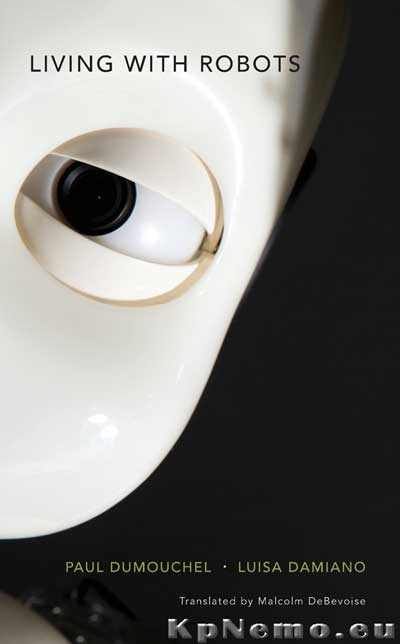
Living with Robots recounts a foundational shift in the field of robotics, from artificial intelligence to artificial empathy, and foreshadows an inflection point in human evolution. Today’s robots engage with human beings in socially meaningful ways, as therapists, trainers, mediators, caregivers, and companions. Social robotics is grounded in artificial intelligence, but the field’s most probing questions explore the nature of the very real human emotions that social robots are designed to emulate.
Social roboticists conduct their inquiries out of necessity―every robot they design incorporates and tests a number of hypotheses about human relationships. Paul Dumouchel and Luisa Damiano show that as roboticists become adept at programming artificial empathy into their creations, they are abandoning the conventional conception of human emotions as discrete, private, internal experiences. Rather, they are reconceiving emotions as a continuum between two actors who coordinate their affective behavior in real time. Rethinking the role of sociability in emotion has also led the field of social robotics to interrogate a number of human ethical assumptions, and to formulate a crucial political insight: there are simply no universal human characteristics for social robots to emulate. What we have instead is a plurality of actors, human and nonhuman, in noninterchangeable relationships.
The present book is chiefly concerned with social robotics, that is, with robots whose primary role, as in the case of Ava, is to interact socially with humans. Today such robots are used mostly in health care and special education. We coined the term “artificial empathy” to describe their performance in settings where the ability to sense human feelings and anticipate affective reactions has a crucial importance. The uses to which artificial social agents may be put is forecast to expand dramatically in the next few years, changing how we live in ways that for the moment can only be guessed at.
Оригинальное название: Living with Robots
Жанр: Робототехника
Автор: Paul Dumouchel, Luisa Damiano
Год издания: 2017
Формат: EPUB
Язык: Английский
Количество страниц: 280
Размер архивов (файлов): 12.2 MB
Скачать:
 ernesto
 trey
206 лет назад, 28 ноября 1820 года родился Фридрих Энгельс.
В 1849 г. Энгельс писал в "Neue Rheinische":
«Славянские народы Европы — жалкие вымирающие нации, обреченные на уничтожение. По своей сути процесс этот глубоко прогрессивен. Примитивные славяне, ничего не давшие мировой культуре, будут поглощены передовой цивилизованной германской расой.
Всякие же попытки возродить славянство, исходящие из азиатской России, являются „ненаучными“ и „антиисторическими“. В конечном счете, немцам и германизированным евреям должны принадлежать не только славянские области Европы, но и Константинополь» («Революция и контрреволюция в Германии»).
«Необходима безжалостная борьба не на жизнь, а на смерть с предательским по отношению к революции славянством, истребительная война и безудержный террор… У Европы только одна альтернатива: либо подчиниться игу славян, либо окончательно разрушить центр этой враждебной силы — Россию…